FusionAMM - The Gold Standard
Investment Disclosure:
This article will be discussing FusionAMM, a protocol created, owned and operated by DeFiTuna. As the author of this article I have personally been involved in the community for over half a year and have made substantial investments into their token $TUNA. I do not wish for this breakdown to come across as "shilling" or confirmation bias (that's what X is for). I will not mention anything other than the FusionAMM architecture any further. Any comparisons to other protocols are made solely for context and carry no intent of promotion or criticism.
This article will assume basic knowledge of how order books and liquidity pools work. I recommend reading my liquidity pool article if you aren't familiar with these concepts.
The Problem
Liquidity pools are great! They have a bunch of really cool features and allow for a ton of cool use cases that wouldn't be possible without them. But traditional order books still have one feature that LPsLiquidity Pools don't. Limit orders.
A limit order is an order to buy or sell an asset at a specific price or better. It guarantees the price, but not that the trade will be executed.
Order books are good at these.... because that's all they are. A set of limit orders. If you want to buy or sell right now, you have to pick the best limit order in the book and use that as the counter party to your trade. Liquidity pools are really good at this kind of order because of how they keep track of price and handle orders. But if you want to set an order to execute at a certain price in a liquidity pool. Things get a bit trickier.
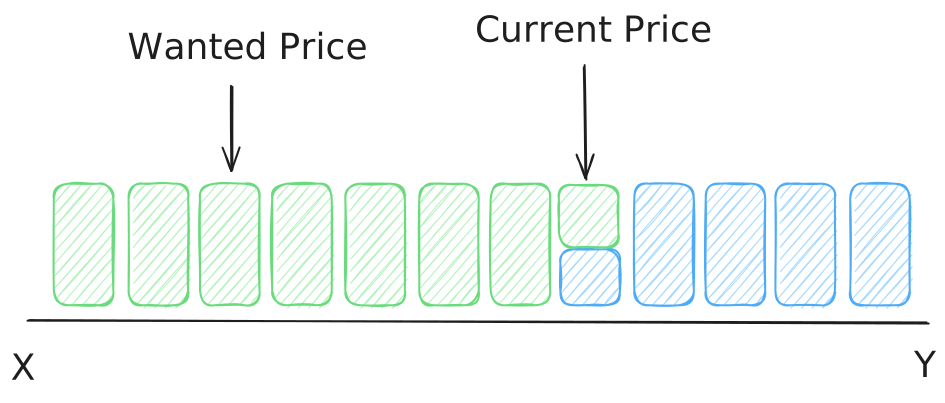
The image above is showing a simplified visualisation of what a LP of SOL-USDC might look like at some price. As you can see, the current price is not where we want to trade. LPs however, don't store discrete orders. They represent a continuous price curve where liquidity exists at all points between ranges, so you can't "wait" for price like in traditional limit order books. Under the hood they keep track of what the current ratio of tokens is (the price) and how it should change as tokens get added or removed but don't keep track of when/if someone wants to buy or sell.
Now that we have established that you can't create limit orders on LPs. Lets go to Jupiter and create limit orders on LPs....
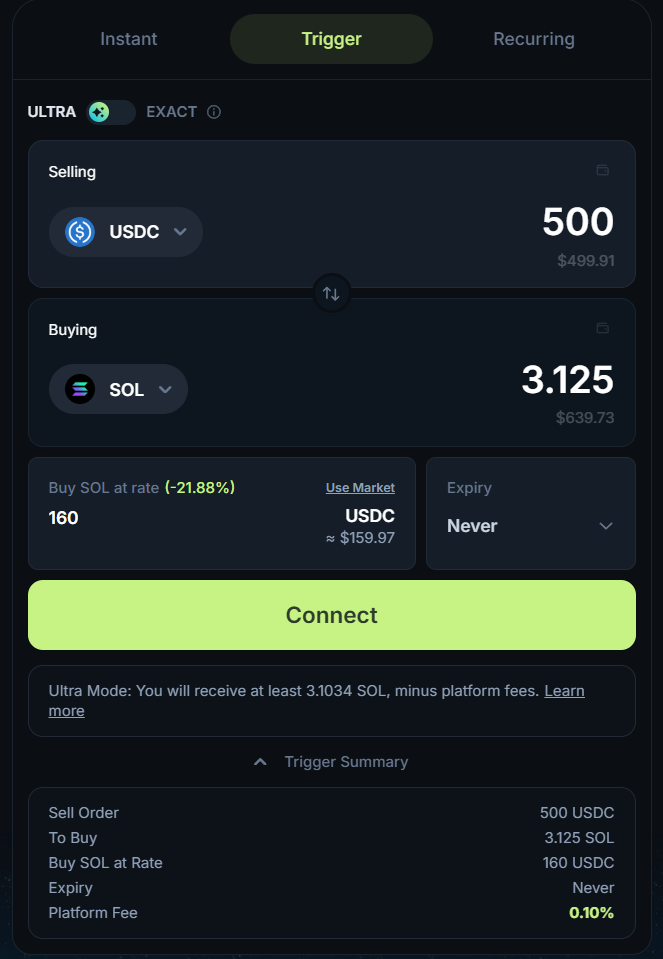
Doesn't seem right, does it? It looks like a limit order. Quacks like a limit order. But is it actually a limit order? The short answer is: "No". But that doesn't make for a good article. So let's dig deeper into what is actually happening.
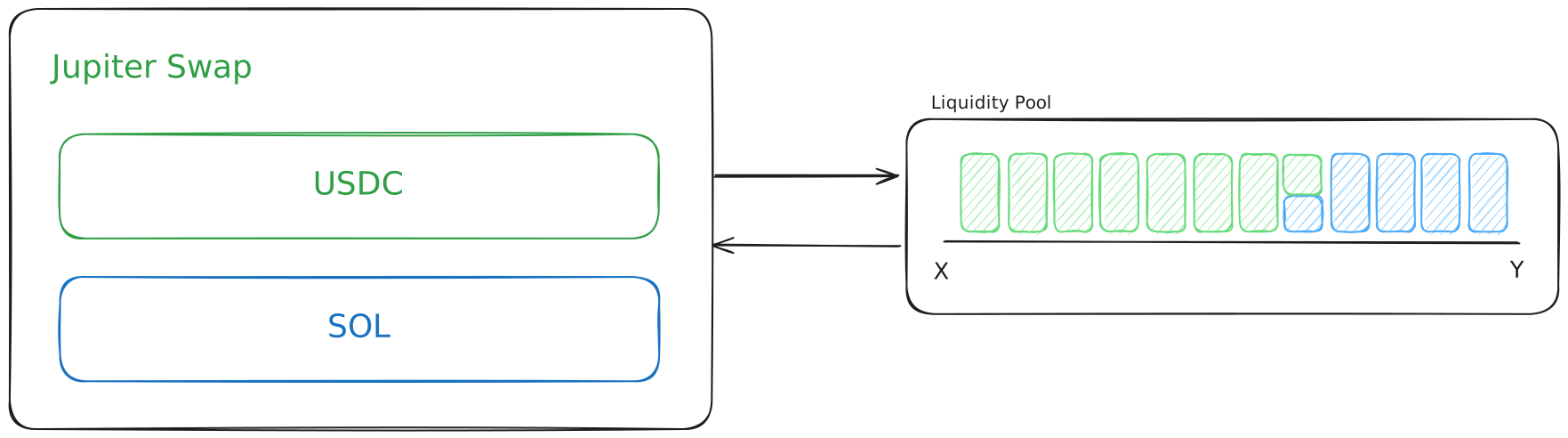
The first clue is the name, "Trigger". The way limit orders execute on LPs is by constantly watching the price. Once it hits the required level, a transaction is sent to execute the swap. Issue is, this is really inefficient. Imagine yourself in Jupiter's position. Thousands of tokens, each one could have one or hundreds of pools. Thousands of users placing millions of orders on different pools at different prices. And every user expects to have their order filled at the price they requested. That creates immense cost for Jupiter. And the worst part is, fills aren't guaranteed. If your order isn't the fastest or not quick enough you may not buy at the price you requested, or you might only buy a portion of the amount you wanted. Also consider other providers of limit orders. When everyone wants to be the first to get the best price, speed is vital, and more speed = more cost.
Note: There are on-chain order books and protocols that use order books. But these in turn lose the advantages of LPs
The Solution
Make the limit orders part of the liquidity. Simple. Efficient. Ingenious.
FusionAMM does this by allowing users to place limit orders that the pool keeps track of between ticksThe smallest price interval in the pool (represented by coloured square in the diagrams). This means that in order for price to move past a level, all liquidity and limit orders on that level have to be consumed.
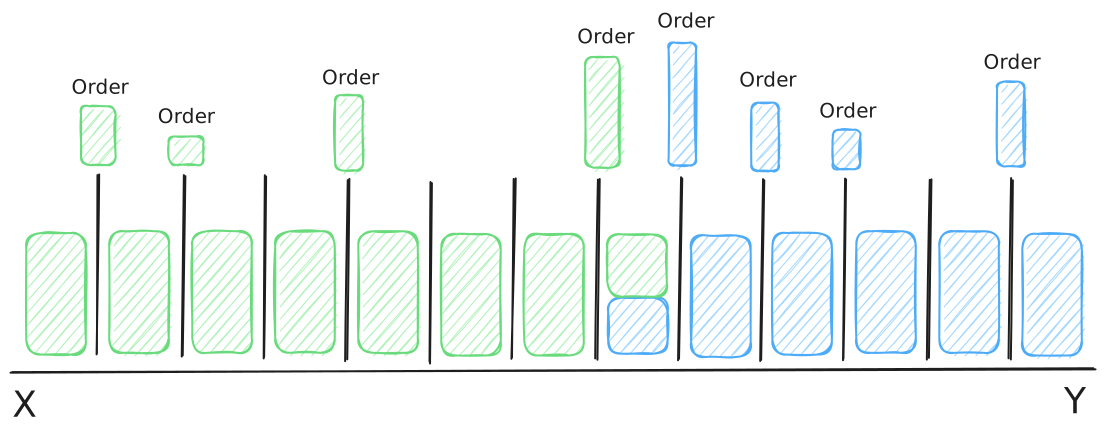
And if we flip the whole thing on its side and hide the core liquidity itself....
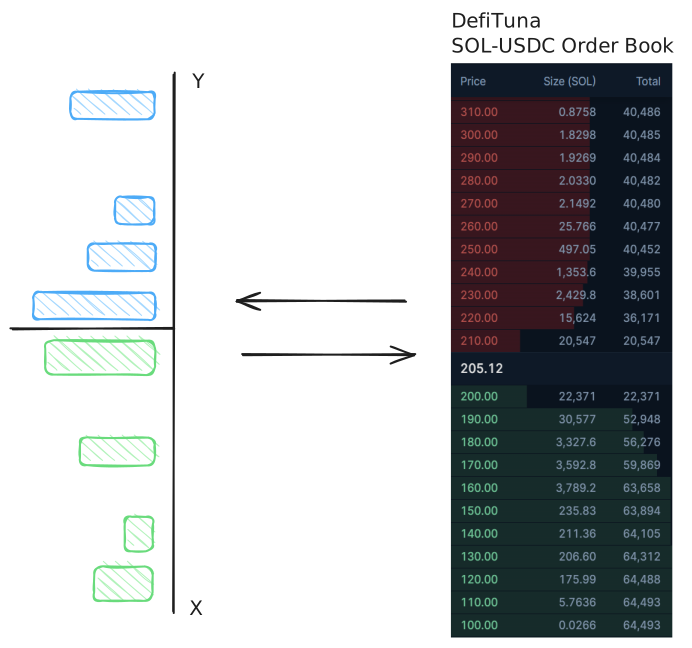 By managing orders in this way we get a bunch of benefits:
- Orders are executed faster
- Orders are executed more accurately
- Execution is cheaper (just a small fee for the user)
- No risk of partial fills even though price moved past limit order
This finally gives AMMs the final leg up on traditional order books.
Advanced Technical Note
By blending LP and limit order mechanics, FusionAMM achieves real-time, precise execution without external infrastructure. However, this architectural elegance trades off multi-path routing efficiency. Unlike aggregators like Jupiter—which split large trades across multiple liquidity sources to minimize slippage—FusionAMM executes trades solely through the pool they originate in. That doesn't inherently increase slippage at the limit price, but it means large orders may depend on arbitrageurs to be filled when pool volume is insufficient.
Conclusion
FusionAMM isn’t about reinventing the wheel—it’s about putting better tires on the one we’ve been using for years. By collapsing liquidity and limit orders into the same pool, execution becomes smoother, cheaper, and far more intuitive for both traders and protocols.
So if you’re still clinging to spaghetti-routing across 12 different venues, paying a premium just to outbid the next bot in line, go ahead—your bags will thank you (eventually). But for the rest of us? The future looks refreshingly obvious.
After all, the best innovations are the ones that make you wonder: "Why weren’t we doing this the whole time?"
I encourage you to take a look at the official FusionAMM website and their docs
Thank you for reading.